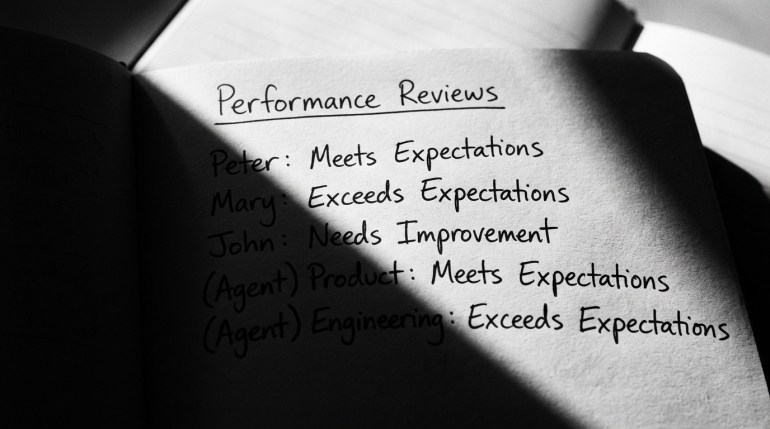
Accountable Workplaces

By Andre Lessa, August 2026

The next transformation of work will not be defined by a chatbot sitting in the corner of a browser. It will be defined by organizations learning how to coordinate human judgment, enterprise data, and fleets of AI agents into a new operating model. The companies that succeed will not simply “use AI.” They will build accountable workplaces.

An accountable workplace is not a workplace where people are replaced by machines. It is a workplace where every department gains an AI capacity layer: agents that can observe, reason, draft, monitor, summarize, recommend, and, within well-defined limits, act. These agents do not sit outside the business as novelty tools. They become part of how the business listens to itself, remembers what it knows, and moves work from intention to execution. Most importantly, they operate inside a clear chain of human responsibility.

That distinction matters. The first wave of enterprise AI has mostly been individual and optional. Employees ask questions, upload files, generate drafts, summarize meetings, or use AI as a faster search box. Useful, yes, but still peripheral. The real change begins when AI is connected to the systems where work already happens: CRM, ticketing, contracts, calendars, support channels, project plans, finance systems, knowledge bases, product roadmaps, and internal communications. At that point, AI is no longer a tool someone occasionally consults. It becomes part of the workplace itself.

Continue reading

RAGs to Riches

There’s something incredibly exciting about recognizing patterns in technology cycles.

The current AI wave feels like a sudden gold rush. But gold rushes don’t create gold. They reveal what was already there.

Large language models (LLMs) are trained on vast amounts of data, but that knowledge is static at the moment training ends. They do not automatically know your latest documents, your internal data, or what changed yesterday. Retrieval-Augmented Generation (RAG) systems are used to bridge that gap. By retrieving relevant information in real time and injecting it as context, we can augment what the model sees and improve what it predicts next.

And beneath that entire mechanism lies a discipline that has been evolving for decades: information retrieval.

This post explores how modern AI architectures build on earlier search technologies, what truly changed when retrieval began feeding generative models, and why the real riches belong to those who understand the foundations.

Continue reading

Running a Perceptron on an 8-bit computer

Building AI on an 8-bit Machine: A Throwback to Retro Coding

What if I told you that you could write AI code on a computer from nearly 40 years ago?🕹️

My 8-bit TK90X, a ZX-Spectrum clone.

In a world dominated by GenAI and LLM advancements, I decided to take a step back – way back – to the era of 8-bit computing. This journey isn’t just about nostalgia; it’s a deep dive into how early computing shaped the way we code today and a challenge to build AI on extremely limited hardware.

Want to see the code in action?

Continue reading